
Twogether Updates
Day Habilitation: Update on “Off-Site” DH Services
September 5th, 2021
HHSC Publishes In-Home Day Habilitation Information for Program Providers for COVID-19 (IL 2021-39)
The Texas HHSC is temporarily waiving certain requirements in Section 3710, 4381.3, 4381.7(6) and 4381.7(7) of the Home and Community-based Services Billing Guidelines and the Texas Home Living Billing Guidelines.
This is in response to COVID-19 and to provide access to needed day habilitation services.
HHSC has published a revision to this guidance, IL 2021-39 In-Home Day Habilitation Information for Program Providers for COVID-19 (PDF), replacing IL 2021-33.
It extends the temporary guidance through September 30, 2021.
Email questions to HCSPolicy@hhsc.state.tx.us
May 3rd, 2021
HHSC Publishes In-Home Day Habilitation Information for Program Providers for COVID-19 (IL 2021-20)
The Texas HHSC is temporarily waiving certain requirements in Section 3710, 4381.3, 4381.7(6) and 4381.7(7) of the Home and Community-based Services Billing Guidelines and the Texas Home Living Billing Guidelines.
This is in response to COVID-19 and to provide access to needed day habilitation services.
HHSC has published a revision to this guidance IL 2021-20 In-Home Day Habilitation Information for Program Providers for COVID-19 (PDF) which replaces IL 2021-16. It extends the temporary guidance through
May 31, 2021.
Email questions to HCS Policy.
April 17th, 2021
Revisions to Guidance For Day Habilitation Providers Coming!
HHSC and DSHS are working on revisions to the DSHS Guidance for DHs. Once revisions are finalized HHSC will notify providers.
March 25th, 2021
Program Provider Response to COVID-19 and Visitation Expansion-
Day Habilitation Off-Site
2.1.8 Day Habilitation and Outside Employment
Individuals receiving HCS or TxHmL services can choose to attend off-site day habilitation that is in compliance with DSHS Checklist for Day Habilitation Sites or outside employment with documented informed decision-making.
• The program provider’s infection control policy must include provisions specific to those attending off-site day habilitation, employment, or any other community activity to ensure the health and safety of individuals.
• The program provider must screen individuals for fever and other signs and symptoms of COVID-19 upon their return to the residence.
• If program provider staff does not provide transportation, the program provider should arrange for pick-up and drop-off to occur outside the residence when possible. If transportation staff must enter the residence to prepare individuals for transportation, they must be screened and wearing a face mask.
• Program providers must provide oversight of day habilitation settings to ensure compliance with their contract. They must request documentation (e.g., policies, plans, procedures) from the day habilitation site that demonstrates how it plans to comply with DSHS guidance. For outside employment, the program provider must request from the employer information on how the employer is responding to COVID-19 to protect its employees.
PL 21-09 March 25, 2021 Page 5 of 20
• The program provider must ensure individuals are supplied with masks or cloth face coverings and encourage their appropriate use, unless contraindicated. The provider cannot charge individuals for facemasks or face coverings.
Providers are responsible for ensuring the health and safety of the individuals in their care. In the context of deciding whether to attend outside day habilitation sites, the program provider fulfills this responsibility by participating in the informed decision-making process, which includes:
• Providing a full list of available options and alternatives, including in-home day habilitation, if available;
• Assessing the risks of attending day habilitation;
• Providing training on PPE, hygiene, and physical distancing;
• Except for individuals in host-home and own home/family home settings, ensuring that individuals have access to PPE.
For individuals in a host home and own home/family home settings, the program provider must encourage individuals to wear a facemask or face covering over the nose and mouth and use any other required PPE necessary to safely attend the day habilitation site.
The program provider must only contract with a day habilitation site that agrees to comply with DSHS guidance. As part of its contractual oversight of the day habilitation site, the HCS or TxHmL program provider should set up a system to monitor compliance with DSHS guidance.
In addition, the program provider must include in its contract a requirement for the day habilitation site to inform individuals, program providers, staff, and family when it is aware of probable or confirmed cases of COVID-19 among staff or the individuals it serves. However, a day habilitation site must not release personally-identifying information regarding confirmed or probable cases.
Informal Dispute Resolution Process-HCS/TxHmL/ICF
September 5th, 2021
HHSC Publishes Revised Informal Dispute Resolution (PL 2021-07)
HHSC published a revised version of Provider Letter 2021-07, Informal Dispute Resolution (PDF). A revision was made to update the contact phone number.
.
The Informal Dispute Resolution (IDR) process gives nursing facilities, assisted living facilities, intermediate care facilities, Home and Community-based Service and Texas Home Living waiver providers the opportunity to informally dispute regulatory survey findings. (Texas Government Code §531.058 and Human Resources Code §161.0892).
In accordance with Senate Bill 304, 84th Texas Legislature, 2015, and House Bill 2590, 85th Legislature, 2017, the Texas Health and Human Services Commission has contracted with Michigan Peer Review Organization (MPRO) to perform IDR reviews and make a recommendation of compliance or non-compliance.
To request an IDR, facilities must submit via email a fully executed IDR Request Form to the HHSC IDR Department within 10 calendar days of receiving the official Statement of Deficiencies (Forms 2567/3724) or Final Report. If a timely request is made for an IDR, HHSC will forward the request to MPRO. Facilities/providers are then required to submit a rebuttal letter and supporting documentation directly to MPRO within the required timeframes.
Request Forms
Due Dates
Supporting documentation due dates are as follows:
- For NFs, ICF and the HCS/TxHML waiver providers the due date is the 5th calendar day after submitting the IDR Request form to HHSC on time.
Note: If the due date falls on a Saturday, Sunday or legal holiday, the due date becomes the next business day.
Where to Submit Your Supporting Documentation
All rebuttal information may be submitted via MPROs IDR Secure Application. Find instructions and link at www.mpro.org/texas-idr, or by mail to the address below:
MPRO – IDR Department
22670 Haggerty Road, Suite 100
Farmington Hills, MI 48335
www.mpro.org/texas-idr
For questions or problems with submitting supporting documentation, contact MPRO:
Aris Rhodes-Bond, IDR Project Specialist
248-465-7405
Charlene Kawchak-Belitsky, IDR Senior Manager
248-465-1038
Email: iidrgroup@mpro.org
Texas Administrative Code rules for IDR
For questions or problems with submitting the IDR Request Form, contact IDR:
HHSC IDR Department
IDR@hhsc.state.tx.us
512-706-7268
HHSC Changes To Structure, Organization, and Contact Info: Survey & Certification (HCS/TxHmL)

September 1st, 2021
The Health and Human Services Commission created the Regulatory Services Division (RSD) in 2017 as regulatory functions consolidated from the Department of Family and Protective Services (DFPS), the Department of Aging and Disability Services (DADS), and the Department of State Health Services (DSHS). As part of this consolidation effort, new teams were developed while keeping the division’s core values of quality, consistency, efficiency, and accountability in mind. RSD LTCR continues to move forward with transformational activities and the next phase includes the integration of the Waiver Survey and Certification Unit into Survey Operations and regional structure. This transition occurred as of August 30, 2021. Revisions have been made as part of this process to reflect changes on how to file a complaint regarding an HCS or TxHmL surveyor.
The Waiver Survey and Certification Program Managers and survey teams will report to the Assistant Regional Director and Regional Director in their respective regions.
Disaster Preparedness: Requests To Exceed License Capacity Due to an Emergency
Requests For Exceeding Licensed Capacity During Severe Gulf Coast Weather
HHSC Long-term Care Regulation is reminding providers to be ready to implement emergency preparedness plans. If your facility is impacted by severe weather such as wind or flooding, or is in an area under mandatory evacuation orders, contact the HHSC LTCR Regional Director in the region where the facility is located.
In addition to contacting the HHSC LTCR RD, all requests to exceed licensed capacity due to an emergency must be approved by the director of survey operations. If your facility is projected to exceed its licensed capacity because it is accepting residents who have been evacuated from another facility, email Renee Blanch-Haley and include State Capacity Increase Request in the subject line.
If you have any questions, contact your HHSC LTCR RD, email LTCR Policy and Rules or call 512-438-3161.
LTC Provider Reporting Guidelines as COVID-19 Cases Surge (ICF Providers)
August 26, 2021
Assisted living facilities, nursing facilities, and intermediate care facilities for people with intellectual disabilities are only required to report COVID-19 cases in residents or staff to HHSC if:
- It is the facility’s first ever COVID-19 case
- It is the facility’s first case after having had no COVID-19 cases among staff or residents for 14 days or longer
Read Provider Letter 2021-04 (PDF).
Email questions to LTCR Policy for more information, including a decision tree on when to report.
LTC COVID-19 and Visitation Expansion Rules For in HCS in Texas
August 25th, 2021
Program Provider Response to COVID-19 and Visitation Expansion for HCS
(PL 2021-30)
HHSC published Provider Letter 2021-30 Program Provider Response to COVID-19 and Visitation Expansion for HCS. This letter replaces PL 2021-09. This letter describes the actions a program provider must take to mitigate COVID-19 according to Executive Order GA-38(link is external) and CDC guidance and the criteria for expanded indoor and outdoor visitation as well as essential caregiver visits.
As part of the continued reopening of the State of Texas, the Texas Health and Human Services Commission (HHSC) has published new Home and Community-based Services (HCS) Program Provider Response to COVID-19 Emergency Rule1 and HCS Expansion of Reopening Visitation Rule2.
HCS Program Provider Response to COVID-19 Emergency Rule HHSC published new HCS Program Provider Response to COVID-19 – Mitigation Rules effective August 21, 2021. These new rules replace the previous COVID-19 mitigation rules. See the HCS Program Provider Response to COVID-19 Emergency Rule at 40 TAC 9.198 for the complete list of requirements. Notable updates include the following.
HHSC added the definition for a “fully vaccinated person,” which is a person who received the second dose in a two-dose series or a single dose of a one-dose COVID-19 vaccine and 14 days have passed since this dose was received
•regularly disinfecting all high-touch surfaces, such as counters, doorknobs, telephones, etc.
(PL 2021-09) on Visitation Expansion
(This letter was published March 25th, 2021)
(PL 2021-09) on Visitation Expansion is no longer in place as of August 2021. It replaced the following Provider Letters: PLs 2020-22 and 2020-40
September 21st, 2020
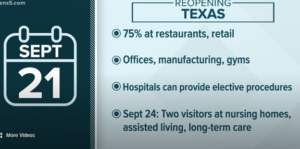
An ICF resident, as well as an individual living in an HCS group home, may have up to 2 Essential caregivers, as defined in the emergency rules, and they must have a negative COVID-19 test result from a test performed no more than 14 days before the first essential caregiver visit unless the facility chooses to perform a rapid test prior to entry into the facility. Providers are still seeking clarification for some of the new COVID-19 emergency mitigation rules (including visitation rules) for persons receiving HH/CC services. We plan to keep you updated!
Expanded ReopeningVisitation:
Phase 1 requirements all remain in place (except for compassionate care visits, which are being replaced with less restrictive essential caregiver visits.)
All facilities without an active facility acquired outbreak can move to visitation as outlined in the emergency rules(including those with isolation wings), but visitation is only allowed for residents/individuals, who are NOT COVID positive and in areas away from COVID positive isolation areas.
Essential caregivers will be trained by the facility on PPE use and infection control, and they must meet the testing requirement.
Reopening is optional for facilities; those that do not feel they have the resources to re-open safely will not be mandated to open or allow for essential caregivers.
See the link below for more information on Visitation Rules for LTC Facilities, including ICF and HCS
https://hhs.texas.gov/sites/default/files/documents/services/health/coronavirus-covid-19/reopening-visitation-ltc-facilities.pdf
HCS/TXHML Survey Operations Transformation (PL 2021-26)

August 15th, 2021
HHSC Publishes HCS and TxHmL Survey Operations Transformation (PL 2021-26)
In advance of the HCS Waiver Survey and Certification unit’s transition to Long-term Care Survey Operations, HHSC has published PL 2021-26, HCS and TxHmL Survey Operations Transformation (PDF). The letter provides information about HHSC’s transformation efforts and what HCS and TxHmL program providers can expect on August 30, 2021.
Information Letter No. 21-32 –Requirements for IPC Submissions for Individuals Requesting Services Funded with GR
August 1st, 2021
Information Letter No. 21-32 –Requirements for IPC Submissions for Individuals Requesting Services Funded with General Revenue
This information letter describes the documentation that a CLASS case manager, DBMD program provider, HCS service coordinator, or HCS program provider must submit to HHSC to request the use of general revenue to pay for services above the individual cost limit of a waiver program.
To justify a request to use general revenue when an individual is enrolling in the CLASS, DBMD, or HCS Program or when an individual’s individual plan of care (IPC) is being revised or renewed:
● The individual’s IPC must be electronically transmitted to HHSC using the HHSC Data System.
● The following additional documentation must be submitted to HHSC through the HHSC portal, or by email or regular mail:
An IPC that is identical to the electronically transmitted IPC and contains all required signatures of the service planning team
For an individual in the HCS Program, the person-directed plan and implementation plans for all services included on the IPC
For an individual in the CLASS or DBMD Program, the individual program plan
A current comprehensive nursing assessment by a registered nurse who is employed by or contracts with the CLASS direct services agency, or the HCS or DBMD program provider
Physician orders used by the registered nurse to develop the IPC
If a home and community support services agency will provide the nursing on the IPC, CMS form 485, Home Health Certification and Plan of Care
If a nurse employed by or contracting with an HCS program provider will provide the nursing on the IPC, documentation containing the same information as CMS form 485, signed by a physician
Nursing notes from the two-week period immediately preceding submission of the documentation
Medication administration record sheets from the two-month period immediately preceding submission of the documentation
Records, notes, and orders of a primary care or specialty physician that are relevant to the services on the IPC, including office visit notes documenting the individual’s current medical conditions. Preprinted after-visit instructions and office notes from a nurse, nurse practitioner, or physician assistant do not meet this requirement. Office visit notes must be dated within the 12-month period immediately preceding submission of the documentation.
The following additional documentation, if relevant, may be submitted to HHSC to justify a request to use general revenue when an individual is enrolling in the CLASS, DBMD, or HCS Program or when an individual’s IPC is being revised or renewed:
● Records related to an individual’s health, such as blood sugar levels, bowel movements, seizures, and suctioning
● Hospitalization paperwork and discharge notes from the one-year period immediately preceding the submission of documentation
● Documentation to support unusual or new diagnoses, such as a comatose or vegetative state
● Hospice assessment, if applicable
● Community First Choice Personal Assistance Services/Habilitation Assessment form
● Evidence of a determination of whether to delegate health maintenance activities, as defined in 22 TAC §225.4, and, if delegated, documentation of delegation monitoring, such as nursing notes describing monitoring or training of unlicensed staff
A CLASS case manager, DBMD program provider, HCS service coordinator, or HCS program provider must respond to a request from HHSC for additional information.
When an IPC is being renewed, the documentation described in this letter must be submitted 30-60 days before the effective date of the renewal IPC.
HHSC does not authorize an IPC for which general revenue is requested until a review of the documentation described in this letter is completed by HHSC.
If you have any questions about submitting a request to use general revenue to pay for services above the individual cost limit of a waiver program, please call Utilization Review at: (512) 438-5055.
Update to COVID-19 Guidance for SC’s Concerning SC Visits & Contacts
Update to COVID-19 Guidance for Service Coordinators
Fee-for-service Medicaid 1915(c) waiver case managers and service coordinators may use telehealth or the phone to conduct service coordination visits. This temporary policy change extends through Aug. 31, 2021.
SC’s are encouraged to complete visits by phone, telehealth or telemedicine.
Program providers must complete the required background checks for all service providers. They must follow:
- The Texas Administrative Code, Title 40, Part 1, Subchapter D and N
- HCS and TxHmL Rules,§9.177 (n) and (o), and §9.579 (r) and (s)
- HCS and TxHmL Billing Guidelines (PDF) Section 3400 for service provider qualifications
Texas Medicaid 1115 Transformation Waiver Update
July 17th, 2021
Texas Medicaid 1115 Transformation Waiver Extension
HHSC announces its submission of an extension application to the Centers for Medicare & Medicaid Services (CMS) for the Texas Healthcare Transformation Quality Improvement Program (THTQIP) waiver under section 1115 of the Social Security Act.
The extension request is for approximately 10 years, which will provide the 1115 waiver authority through 2030. The extension reflects the same terms and conditions agreed to and approved by CMS on Jan. 15, 2021.
The requested extension will allow Texas continued flexibility to pursue the goals of the existing 1115 waiver:
- Expand risk-based managed care to new populations and services.
- Support the development and maintenance of a coordinated care delivery system.
- Improve outcomes while containing cost growth.
- Transition to quality-based payment systems for managed care and providers.
Stakeholders may take part in a meeting regarding the waiver application next Tuesday:
July 20, 2021
11 a.m. Central time
Stakeholders may review the final application posted here.
Stakeholder Webinar: HCS Funding-American Rescue Plan Act – July 15, 2021
The American Rescue Plan Act (ARPA) of 2021 was signed into law on March 11, 2021. Section 9817 of ARPA provides states with a temporary ten (10) percentage point increase to the federal medical assistance percentage (FMAP) for Medicaid Home and Community-Based Services (HCBS), if certain federal requirements are met. States must use funds equivalent to the amount of federal funds attributable to the increased FMAP to implement activities that enhance or strengthen Medicaid HCBS. The Health and Human Services Commission (HHSC) submitted an initial spending plan to the Centers for Medicare and Medicaid Services (CMS) on July 12, 2021.
The plan Texas submitted is contingent upon federal clarification on outstanding questions.vTexas proposes to use state general revenue to fund projects to:
- Support providers of HCBS and community-based long-term services and supports (LTSS);
- Support recipients in HCBS programs; and
- Enhance and strengthen the HCBS infrastructure in Texas.
Please join HHSC on Thursday, July 15 at 10:00 a.m. for a webinar with stakeholders. HHSC staff will provide information about the contents of the plan, next steps, and answer stakeholder questions. Register here to join the webinar(link is external).
Proposed Billing Guidelines HCS/TxHmL

Stakeholder Comments Requested for HCS, TxHmL Billing Guidelines, As Well As Proposed Billing Requirements, Provider Fiscal Compliance and TMHP Revisions
HCS and TxHmL Stakeholders can now comment to the HCS, TxHmL and CFC Billing Guidelines by July 18, 2021 about the proposed revisions:
- Proposed Billing Requirements
- Provider Fiscal Compliance
- TMHP revisions
The proposed billing guidelines revisions and a summary of changes were posted on June 18, 2021. They are located on the Long-term Care Providers page and are outlined below:
HCS
TxHmL
Announcement Of The STAR+PLUS Pilot Program Site
July 2nd, 2021
HHSC selected the Bexar service area as the primary service area in which to operate the STAR+PLUS Pilot Program
Yesterday members of the IDD SRAC and STAR+PLUS Pilot Program Workgroup were sent the notice below regarding selection of the STAR+PLUS Pilot site. As the result of HB 4533 (Klick – 86th Session) Chapter 534, Government Code was amended and, among other changes, directs the pilot to assist in evaluating and developing a plan for the transition of all or some of the long term services and supports currently provided through the non-residential services provided through the HCS, TxHmL, CLASS and DBMD waiver programs. Chapter 534, Government Code calls for the pilot to start 9-1-2023 and conclude on 9-1-2025.
Notes: i) Prior to consideration of the transition of the residential services provided through the community-based ICF/IID program and the HCS and DBMD waivers, Chapter 534 calls for a separate pilot. ii) It is not known at this time how the STAR+PLUS procurement process will impact the number of and current MCOs in the Bexar STAR+PLUS service area. The procurement is expected to be released in Q2 of FY 2022 with awards to be announced in Q3 of FY 2023 and an operational start date of Q1 of FY 2024.
Message to Members of the IDD SRAC and the STAR+PLUS Pilot program Workgroup: Texas Government Code, Section 534.106(c) states the pilot program shall be conducted in a STAR+PLUS Medicaid managed care service area selected by the Health and Human Services Commission (HHSC).
HHSC has also identified two backup service areas if unforeseen circumstances prevent operation in the Bexar service area that are prioritized in the following order:
1. MRSA Northeast
2. Tarrant.
This link shows the Medicaid managed care service areas.
EVV Contact Information

July 3rd, 2021
Updates to HHSC EVV Mailboxes and Website
HHSC EVV Mailboxes
By June 28, HHSC EVV Operations will update their electronic mailboxes to the following email addresses:
- HHSC Electronic Visit Verification Mailbox: EVV@hhs.texas.gov
- Previous email address: Electronic_Visit_Verification@hhsc.state.tx.us
- HHSC EVV Proprietary Systems Mailbox: EVVPSO@hhs.texas.gov
- Previous email address: EVV_PSO@hhs.texas.gov
Additional Information
- Assess all personal materials, such as contact matrices, for any updates needed.
- Always refer to the HHSC EVV website for current information and resources.
- HHSC EVV Operations will continue receiving emails if a previous email address is used.
HHSC EVV Website
Throughout June and July, the HHSC EVV website and some of its webpages will have a new layout to reorganize resources and include updates related to the 21st Century Cures Act, Section 12006.
Email the HHSC EVV Mailbox with any related inquiries.
February 7th, 2021
Electronic Visit Verification (EVV) Contact Information
For questions about Claims, providers should call the TMHP EDI Helpdesk at: 888-863-3638,
Option 4, including questions about:
•
Electronic Data Interchange (EDI) – Submitting Claims for EVV.
•
Claim Rejections (excluding Long-Term Care [LTC] claim rejections with error code F, RJ, and/or AC).
For questions about EVV Claims Processing, contact the entity that pays or denies your claims
(i.e., the managed care organization [MCO]. There is a list of MCO phone numbers at the end of this post).
For questions about EVV Claims Processing that are specific to TMHP call:
•
LTC: 800-626-4117, Option 1, then Option 6.
•
Acute Care: 800-925-9126, Option 7.
For EVV general complaints questions, contact:
•
HHSC Program Providers email: Electronic_Visit_Verification@hhsc.state.tx.us.
•
MCO Program Providers at your MCO’s EVV mailbox (listed at end of this post)
For questions about MCO complaints, email: HHSC Managed Care Compliance and Operations at:
HPM_Complaints@hhsc.state.tx.us.
For questions about EVV Vendor complaints, email the TMHP EVV mailbox at: EVV@tmhp.com.
If you have questions about policy and compliance, contact:
email the HHSC EVV Operations mailbox at: Electronic_Visit_Verification@hhsc.state.tx.us.
Questions may include:
•
Rules.
•
Programs and Services Required to Use EVV.
•
The 21st Century Cures Act.
For general questions about EVV policy and compliance reviews, contact HHSC Program Providers at: Electronic_Visit_Verification@hhsc.state.tx.us
or
the MCO Program Providers at your MCO’s EVV mailbox (See page 18 for a list of email addresses).
Questions may include:
•
Allowable Phone Identification and Recoupment.
•
Compliance Oversight.
•
Reason Codes.
•
EVV Usage.
•
Policy and Requirements.
•
EVV Reports and Understanding EVV Reports.
•
Visit Maintenance and Unlock Request Policy.
•
Reason Codes.
For questions about the EVV Portal, email the TMHP EVV mailbox at
EVV@tmhp.com
or
contact the EVV Vendor (See EVV Vendor list at the end of this post).
Questions may include:
•
General Support.
•
EVV Provider Onboarding.
•
EVV Reports in the Vendor System.
•
EVV Visit Transactions – Includes Accepted and/or Rejected EVV Visit Transactions.
For questions about TexMedConnect and Electronic Data Interchange call the TMHP EDI Helpdesk at: 888-863-3638, Option 4.
Questions may include:
•
File Submission Errors.
•
Form Processing (i.e., EDI Agreement, TPA, and TPAEF).
•
PIMS Assistance.
•
Submitter IDs – Creation and Modification.
•
TexMedConnect and EDI – Account Setup, Submitting Claims for EVV.
For questions about training on the EVV Vendor System, contact the EVV Vendor (See EVV Vendor list at the end of this post).
Questions may include:
•
General questions.
•
Accessing Reports.
•
EVV Clock In and Clock Out Methods.
•
Making Corrections through Visit Maintenance.
For questions about TMHP Systems training, email questions to the TMHP EVV mailbox at:EVV@tmhp.com.
Note: For non-system-related EVV Policy questions email the HHSC Program Providers at:Electronic_Visit_Verification@hhsc.state.tx.us
or
the MCO Program Providers at your MCO’s EVV mailbox (See below for a list of email addresses).
Questions may include:
•
EVV Portal and EVV Standard Reports.
•
Claims submission.
EVV Vendor list
DataLogic Software, Inc./Vesta:
Phone: 844-880-2400
Email: info@vestaevv.com
First Data Government Solutions/AuthentiCare:
Phone: 877-829-2002
Email: AuthenticareTXSupport@firstdata.com
MCO EVV Contact Information/Contact Information for MCOs
Aetna
844-787-5437
evvmailbox@aetna.com
Amerigroup
800-454-3730
TXEVVSupport@amerigroup.com
Blue Cross Blue Shield
877-784-6802
BCBSTX_EVV_Questions@bcbstx.com
Children’s Medical Center Health Plan
800-947-4969
cmchpevv@childrens.com
Cigna-Health Spring
877-653-0331
providerrelationscentral@healthspring.com
Community First Health
855-607-7827
cfhpevv@cfhp.com
Cook Children’s Health Plan
800-964-2247
CCHPEVV@cookchildrens.org
Driscoll Children’s Health Plan
877-324-7543
evvquestions@dchstx.org
Molina Healthcare of Texas
866-449-6849
mhtxevv@molinahealthcare.com
Superior Health Plan
877-391-5921
SHP.EVV@superiorhealthplan.com
Texas Children’s Health Plan
800-731-8527
EVVGroup@texaschildrens.org
United Health Group
888-887-9003
uhc_evv@uhc.com
House Bill 3240 – Enforcement of Administrative Penalties For HCS/TxHmL/ICF

Turn of Events: Good News For Providers
Bad News For Providers
- Adds a representative from the ICF/IID program to the HHSC LTC Facilities Council
- Aligns assessment of ICF/IID administrative penalties with historical practice, and
- And most importantly for HCS/TxHmL programs, it delays enforcement of administrative penalties, until HHSC develops interpretive guidance for the HCS/TxHmL principles/rules (I imagine much like ICF/IID program has, i.e. Appendix J of Surveyor’s Operational Guide) and completes rewrite of the principles/rules.
- Calls for an ICF/IID representative on the HHSC LTC Facilities Council,
- Caps the amount/$ of administrative penalties which may be imposed per each ICF/IID on-site regulatory visit or complaint investigation,
- Requires HHSC not to enforce an administrative penalty in the HCS or TxHmL waiver programs until interpretive guidelines are developed and adopted, and
- Requires that rules to implement the changes required by HB 3240 be adopted not later than December 1, 2021.
Attention HCS and TxHmL Providers: Issue With CARE System
Due to issues with CARE in the past week or so, HHSC extended the claim submission deadline through Sunday, 05/23/2021 Noon. A special run took place to encompass claims submitted from Sunday 5/23/2021 – Wednesday, 05/26/2021.
** Claims submitted after cutoff Wednesday 5/26/2021 – Friday 5/28/2021, are expected to be processed on normal processing cycle.
FCC Offers Emergency Broadband Benefit with New Program
May 25th, 2021
The Federal Communications Commission is offering an Emergency Broadband Benefit.
This new benefit will:
- Help families and households struggling to afford Internet service during the COVID-19 pandemic.
- Connect eligible households to jobs, critical health care services, virtual classrooms and more.
Read information about the benefit and eligibility requirements here.
CDC Guidance & Governor’s Executive Order GA-36
Updated CDC Guidance and Governor’s Executive Order GA – 36: In light of the Governor’s Executive Order GA-36 issued yesterday, HHSC and DSHS were asked when providers would receive notice of not only the updated CDC Guidance issued last week and its impact on the programs they operate (including the DSHS Day Habilitation Guidance), but also Executive Order GA-36 . Below are the responses from HHSC received.
https://www.texastribune.org/2021/05/18/greg-abbott-texas-mask-mandate/?utm_campaign=trib-social&utm_content=1621362012&utm_medium=social&utm_source=facebook&fbclid=IwAR2C-a9XuRvB3qUjkXhb6vEi6jRo8U8sR_xbLsHcCR5f1ydXr3bArkprJJI
UNTWISE Offers Free On-Demand, Pre-recorded Webinar: “Ethics of Informed Choice” 1 CEU

The University of North Texas Workplace Inclusion & Sustainable Employment (UNTWISE) is offering a free on-demand, prerecorded webinar called Ethics of Informed Choice, which is available through April 22, 2022. This training outlines informed choice and helps contractors, vendors, and Vocational Rehabilitation (VR) staff understand its importance in the VR process. Information on the training can be found on the UNTWISE web page.
“This training will define Informed Choice and help contracted providers and VR staff understand its importance in the VR process. Laws related to informed choice as well as results from the Rehabilitation Council of Texas annual report will be discussed. Best Practices, Ethics of Informed Choice, and Case Studies will be used to outline the role of VR staff and providers.”
Presenter: Lucy Gafford
“Social Media A Practical Guide To Improving Safety”: Free Video To Help Plan For Your Individuals With IDD

Please click on the link below and enjoy this free video presented by Michelle Garcia, Psy.D Clinical Psychologist, and her group. Super helpful in these times!
Social Media A Practical Guide to Improving Safety with Dr. Garcia & Associates
“In addition to counseling and curriculum, Michelle and her team provide psychological and neuropsychological testing for a wide variety of conditions (including autism) with the goal of reducing behavioral challenges and improving quality of life.”
“Take a look at our exciting, new healthy relationships curriculum that we wrote! We have had amazing feedback from school districts and agencies who have started using it. Don’t miss out! Learn more by visiting our website or sign up for a free demonstration at: www.qolcurriculum.com“
TAC 9.175 Certification Principles: Requirements Related to ANE of an Individual
May 16th, 2021
For those of you wanting a separate copy of the ANE TAC principles that were put into the HCS TAC in October of 2019, I have attached links to a few pdf versions for you to use at your facility. These particular set of HCS principles are important to keep handy, especially concerning follow-up timelines as well as who to contact, when to contact and report and what to report. after an allegation.
40 Tex. Admin. Code § 9.175
Certification Principles: Requirements Related to the Abuse, Neglect, and Exploitation of an Individual
or
Where to Sign Up To Receive Weekly LTC Provider Electronic Mailers From HHSC

Attention: HCS, TxHmL, CDS, CLASS, DBMD, ICF/IID, SNF’s, and other HHSC programs
Providers can sign up to receive Gov Delivery, an electronic mailer from HHSC that includes current news and topics of interest for LTC providers.
Find Us On Social Media
Twogether Consulting Social Media pages.
Facebook page: https://www.facebook.com/TwogetherConsultingIDDWaiverConsultants
Instagram Page: https://www.instagram.com/twogetherconsulting/
HHSC Resuming Termination of Waiver Services: HHSC, TxHmL, DMDB and CLASS
May 3rd, 2021
Information Letter No. 2021-19
Termination of Waiver Services during the Public Health Emergency was on hold for eligibility issues, but that is now back in effect as of May 10th, 2021.
This information letter is to notify you that, starting May 10, 2021, HHSC will resume ending waiver services of an individual who is not eligible for CLASS, DBMD, HCS, or TxHmL. This is being done in accordance with a rule promulgated by the federal Centers for Medicare and Medicaid Services (CMS).
During the federal public health emergency (PHE), HHSC has not terminated individuals’ IDD waiver services for most reasons related to eligibility. The only service terminations processed during the PHE have been due to an individual dying, moving out of state, or voluntarily withdrawing from a program.
In accordance with CMS’s Interim Final Rule CMS-9912-IFC, starting May 10, 2021, HHSC will resume processing CLASS, DBMD, HCS, and TxHmL program terminations for individuals who do not meet a program’s eligibility. The rules for program eligibility are:
● §9.155 for HCS,
● §9.556 for TxHmL,
● §42.201 for DBMD, and
● §45.201 for CLASS.
Individuals no longer eligible for a waiver program will have waiver services terminated, but may continue to receive Medicaid state plan services, such as primary care and pharmacy benefits, until the end of the federal PHE.
If there are any additional changes to Medicaid coverage, HHSC will notify individuals at the appropriate time.
To read more, here is Information Letter 2021-19
Contact the following with questions about termination of a person’s program:
HCS, TxHmL, CLASS Program Services:
IDD Program Enrollment and Support Message Line at 512-438-2484.
DBMD Program Services
IDD Utilization Review Message Line at 512-438-4896
Draft Rules: Requirements During an Infectious Disease Outbreak, Epidemic or Pandemic
- Table of Contents: Page 1
- Rule Introduction (purpose, applications, definitions): Pages 2 – 7
- ALFs: Pages 8 – 11
- DAHS: Pages 12 – 15
- HCSSAs: Pages 16-24
- Prescribed Pediatric Extended Care Centers: Pages 25 – 27
- Nursing Homes: Pages 28-37
- ICFs/IID: Pages 38 – 41
- HCS: Pages 42 – 45
- TxHmL: Pages 46 – 47
Medicaid Eligibility Training-HCS
E-Learning Portal Training From HHSC
Direct link to main E-Learning portal page for Medicaid training below:
https://learningportal.hhs.texas.gov/course/index.php?categoryid=42
Monitoring and Maintaining Medicaid Eligibility for HCS/TxHmL


This training will cover initial and ongoing eligibility requirements for participation in Home and Community-Based Services (HCS) and Texas Home Living (TxHmL) programs.
- Financial Eligibility – Medicaid
- Medicaid or SSI
- Medicaid Program Transfers
- Monitoring Medicaid
- Loss of Medicaid – Most Common Reasons
- Best Practices
- Resources and Contacts
To take this course, please click on the course title and then select the “enroll me” button below the course description.
Medicaid 101

Status of IDD-Related Bills
Status of IDD-Related Bills That Are of Relevance To Certain IDD Providers
~ a requirement for HHSC to honor a contract requirement to enable a Medicaid MCO to make the initial and subsequent primary care provider (PCP) assignments and changes as required by law;
~ authorization for an MCO to assign Medicaid members to a PCP based on published criteria that seeks to preserve existing provider-member relationships and considers a member’s proximity to PCPs and other criteria as established by the MCO; and
~ a provision revising limitations on a Medicaid recipient’s authority to disenroll from a managed care plan and switch to a new plan.
HCS Retainer Payments
April 17th, 2021
HCS Retainer Payments Status
We have been informed that CMS has finally approved retainer payments for HCS. Certain provider associations will have the opportunity to review and provide feedback on the draft Information Letter related to the payments. HHSC is also developing rules related to this initiative, but those associations will not be able to provide feedback on them. HHSC will conduct a webinar on the HCS retainer payments.
Additional Training Opportunities

MEDICAID WAIVER PROGRAM WEB-BASED TRAINING FROM HHSC
Abuse Neglect and Exploitation Competency Training and Exam
( WE RECOMMEND HCS/TXHML PROVIDERS HAVE DIRECT SUPPORT STAFF COMPLETE THIS TRAINING)
This training is designed to meet the basic ANE training requirements for staff providing direct care in a community setting. By the end of the training, staff should be able to identify which acts constitute ANE, how to recognize ANE, understand risk factors for ANE, and what methods can be used to address ANE. Additionally, this training includes an introduction to trauma and its impact on the people we serve.
Service providers must complete a test with a score of 80 percent or higher. A training certificate can be printed at the end of this training and kept in staff personnel files to meet training requirements.
To access and complete this free online training, please go to the HHS Learning Portal’s ANE Competency Training course page, create a user login, and follow instructions.
March 16th, 2021
March 4 Recording of Writing Acceptable Plans of Correction Webinar Available
A recording of the March 4, 2021 Writing Acceptable Plans of Correction webinar for HCS and TxHmL program providers is available for those unable to attend.
Listen to the webinar recording here.
December 11, 2020
Plan of Removal
Plan of Removal
This course provides a reference guide for a plan of removal and shows how such a plan differs from a plan of correction.
Intermediate Care Facilities
Writing Acceptable Plans of Correction for ICFs/IDD
https://apps.hhs.texas.gov/PROVIDERS/Training/jointtraining.cfm to register and learn more about other joint provider training.
Scope and Severity Webinar Now Available
HHSC is currently offering a webinar to explain scope and severity for providers impacted by House Bill 2025, 85th Texas Legislature, Regular Session, 2017. The training is designed specifically for providers for whom scope and severity is new to the survey process.
Register for the Scope and Severity Training for ALF, DAHS, ICF/IID and PPECC Providers webinar to see available dates and times here.
Please continue to monitor the website for additional dates and times if you are unable to participate during the dates currently being offered. The webinar will be offered on a regular basis for the next few months.
Register at: https://apps.hhs.texas.gov/providers/training/jointtraining.cfm
Changes to the MWH-IDD Website where TIC Training is Accessed
HHSC Long-term Care Regulatory has issued Provider Letter (PL) 19-08: Trauma-informed Care (TIC) Training to replace PL 16-15. The PL informs providers of changes to the Mental Health Wellness for Individuals with Intellectual and Developmental Disabilities website where TIC training is accessed.
This PL is addressed to Intermediate Care Facilities for Individuals with an Intellectual Disability or Related Conditions providers. Read the details of this PL here.
Re: Governor’s Orders for Masks and Re-Openings of Businesses
Re: Governor’s Orders for Masks and Re-Openings of Businesses
Until further notice providers must continue to adhere to all current COVID-related guidance, rules and infection control policies, according to HHSC. At this time changes to these policies will only occur when CMS and/or the CDC issues revised guidance.
HHSC’s position also applies to rules and guidance related to attendance at DHs:
HCS Rules:
https://hhs.texas.gov/sites/default/files/documents/doing-business-with-hhs/providers/long-term-care/hcs/hcs-covid-19-updated-emergency-rules.pdf
ICF:
The ICF Frequently Asked Questions document addresses day habilitation. See page 18.
View the order at: https://open.texas.gov/uploads/files/organization/opentexas/EO-GA-34-opening-Texas-response-to-COVID-disaster-IMAGE-03-02-2021.pdf
Tax Deadline Extensions for Individuals and Businesses

Tax Deadline Extensions for Individuals and Businesses
The IRS announced last week that because of last month’s winter storms, Texans will have until June 15, 2021, to file their individual and business tax returns and make tax payments.
This includes 2020 individual and business returns normally due on April 15, as well as various 2020 business returns due on March 15. Among other things, this also means that affected taxpayers will have until June 15 to make 2020 IRA contributions. The June 15 deadline also applies to quarterly estimated income tax payments due on April 15 and the quarterly payroll and excise tax returns normally due on April 30.
The IRS automatically provides filing and penalty relief to any taxpayer with an IRS address of record located in the disaster area, so taxpayers do not need to take any additional action to receive relief.
You can read the full announcement on the IRS website below:
https://www.irs.gov/newsroom/victims-of-texas-winter-storms-get-deadline-extensions-and-other-tax-relief
HHSC Contacts for HCS, TxHmL, ICF, and CLASS
HCS/TxHmL & CLASS Programs
If you have questions about CLASS Program Policy, call 512-438-5077, 877-438-5658 or email ClassPolicy@hhsc.state.tx.us.
For questions about HCS Program Policy, call 512-438-4478 or email HCSPolicy@hhsc.state.tx.us.
For questions about TxHmL Program Policy, call 512-438-4639 or email TxHmlPolicy@hhsc.state.tx.us.
(TxHmL) billing and payment reviews, call the Billing and Payment Hotline at: 512-438-5359 or email: HCS.TxHml.BPR@hhsc.state.tx.us.
For questions about policy for HCS TxHmL, email: HCSpolicy@hhsc.state.tx.us or
TxHmLpolicy@hhsc.state.tx.us.
For questions about HCS, TxHmL, CLASS, or DBMD Program Enrollment/Utilization Review (PE/UR): Intellectual Disability‑Related Conditions (ID/RC) Assessment Purpose Codes, Level of Need, Level of Care, and Individual Plan of Care (IPC),
call HCS or TxHmL at: 512-438‑5055 or Fax: 512-438‑4249.
Call CLASS or DBMD at: 512-438-4896 or Fax: 512-438-5135.
For questions about Vendor Holds for HCS/TxHmL, call 512-438-3234 or email: IDDWaiverContractEnrollment@hhsc.state.tx.us.
For questions about Individual Rights (individual/family complaints concerning LIDDA, HCS, and TxHmL), call IDD Ombudsman at 800-252-8154 or email: OmbudsmanIDD@hhsc.state.tx.us. Learn more about the IDD Ombudsman at https://hhs.texas.gov/idd-help.
If you have questions about Medicaid eligibility, applied income, and name changes, contact a Medicaid for the Elderly and People With Disabilities (MEPD) worker, or the Integrated Eligibility and Enrollment (IEE) Call Center at telephone number 2‑1‑1 or visit the website: https://yourtexasbenefits.hhsc.texas.gov/.
If you have questions about Days paid and services paid information for cost reports, use TexMedConnect to submit a batch of CSIs.
If you have questions about Rate Analysis contacts visit this website:
https://rad.hhs.texas.gov/long-term-services-supports/contact-list. Contact information is listed by subject.
If you have questions about how to prepare a cost report (forms and instructions) and approved rates posted, visit this website: rad.hhs.texas.gov/long-term-services-supports then select the appropriate program.
If you have questions about how to sign up for, or obtain direct deposit, or how to sign up for electronic funds transfer, call Accounting at: 512-438‑2410.
If you have questions about how to obtain IRS Form 1099‑Miscellaneous Income, call Accounting at: 512-438‑3189.
For questions about ICF/IID durable medical equipment (DME), DME authorizations, Home and Community‑Based Services (HCS), Texas Home Living Waiver (TxHmL), home modifications, adaptive aids, and dental services approvals, call Provider Claims Services at: 512-438‑2200, Option 5.
ICF/IID
If you have questions about ICF/IID and nursing facility contract enrollment, call 512-438‑2630.
If you have questions about the HHS Quality Monitoring Program, email: QMP@hhsc.state.tx.us.
For questions about Payment information for cost reports or a Quality assurance fee (QAF), call 512-424-6552.
For questions about Health and Human Services Commission Network (HHSCN) connection problems, call 512-438‑4720 or 888-952-4357.
For questions about ICF/IID durable medical equipment (DME), DME authorizations, Home and Community‑Based Services (HCS), Texas Home Living Waiver (TxHmL), home modifications, adaptive aids, and dental services approvals, call Provider Claims Services at: 512-438‑2200, Option 5.
For questions about ICF/IID/Residential Care (RC) Individual Movement Form IMT/service authorization, call Provider Claims Services at: 512-438-2200, Option 1.
For Client Assessment Registration (CARE) System Help Desk for ICF/IID, call 888-952-4357.
Request HHSC Field Support staff.
For questions about Program enrollment/Utilization Review (PE/UR), Intellectual Disability‑Related Conditions (ID/RC) Assessment Purpose Codes, Level of Need, & Level of Care call 512-438‑5055 or Fax: 512-438‑4249.
For questions about Provider contracts and vendor holds for ICF/IID or Provider access to ICF/IID CARE system, call 512-438‑2630.
For questions about MDS 3.0, MDS Purpose Code E, and Forms 3618 and 3619 missing/incorrect information, call Provider Claims Services at: 512-438‑2200, Option 1.
For questions about Rehabilitation and specialized therapy/emergency dental/Customized Power Wheelchair (CPWC) service authorizations, call Provider Claims Services at: 512-438‑2200, Option 6, or
Fax: 512-438-2302.
For questions about invalid or inappropriate recoupments for ICF/IIDs, call the HHSC Help Desk at: 512-438-4720 or 800-214-4175.
For questions about Consumer Rights and Services, call Consumer Rights and Services at: 800‑458‑9858, email: ciicomplaints@hhsc.state.tx.us, or visit the website at: https://hhs.texas.gov/about-hhs/your-rights/consumer-rights-services.
IRS-Certain Medicaid Waiver Payments May Be Excludable From Income
Certain Medicaid Waiver Payments May Be Excludable From Income
See the following IRS page for the full FAQ
https://www.irs.gov/individuals/certain-medicaid-waiver-payments-may-be-excludable-from-income
Last Update: New Q&A’s 1-20 were added on February 23, 2015. The original text and Q&A’s follow at the end.
On January 3, 2014, the Internal Revenue Service issued Notice 2014-7, 2014-4 I.R.B. 445. Notice 2014-7 provides guidance on the federal income tax treatment of certain payments to individual care providers for the care of eligible individuals under a state Medicaid Home and Community-Based Services waiver program described in section 1915(c) of the Social Security Act (Medicaid Waiver payments).
Section 1915(c) enables individuals who otherwise would require care in a hospital, nursing facility, or intermediate care facility to receive care in the individual care provider’s home. The notice provides that the Service will treat these Medicaid waiver payments as difficulty of care payments excludable from gross income under § 131 of the Internal Revenue Code.
Individual care providers who receive Medicaid waiver payments for the care of eligible individuals in their homes and payers of Medicaid waiver payments have raised several questions not addressed in Notice 2014-7. The following questions and answers clarify the notice and provide guidance on the information reporting requirements, and the employment tax requirements for Medicaid waiver payments described in the notice.
Individual Care Provider Questions
Q1. I receive payments under a state Medicaid program other than a Medicaid Home and Community-Based Services waiver program for the personal care of my adult disabled son in our home. May I exclude these payments from gross income?
A1. Whether the Service will treat payments under a state program other than a state Medicaid Home and Community-Based Services waiver program as difficulty of care payments excludable from gross income will depend on the nature of the payments and the purpose and design of the program.
Q2. I moved into my elderly mother’s home to care for her, and I do not have a separate home where I reside. I receive payments under a state Medicaid Home and Community-Based Services waiver program for personal care and supportive home care. Am I considered to be providing care in “the provider’s home” for purposes of Notice 2014-7?
A2. Yes. Under § 131, “the provider’s home” means the place where the provider resides and regularly performs the routines of the provider’s private life, such as shared meals and holidays with family. See Stromme v. Commissioner, 138 T.C. 213 (2012). In this situation, the mother’s home became the provider’s home because it is where the provider resides and regularly performs the routines of the provider’s private life.
Q3. I am an individual who cares for an unrelated elderly person five days a week in her home, and I have a room in the care recipient’s home where I sleep four nights a week. I receive Medicaid waiver payments for this care. On weekends and holidays, I reside with my family in our separate home. May I exclude these payments from gross income?
A3. No. In this situation, the provider works in the care recipient’s home, but the provider has a separate home where the provider resides and regularly performs the routines of the provider’s private life, such as shared meals and holidays with family. Therefore, the provider does not provide care for the care recipient in the provider’s home, and the provider may not exclude the Medicaid waiver payments from gross income.
Q4. I am an individual who cares for an unrelated elderly person seven days a week in her home where I live. I receive Medicaid waiver payments for this care. I do not have another home. May I exclude these payments from gross income?
A4. Yes. In this situation, the care recipient’s home is also the care provider’s home, and the care provider does not have a separate home. Therefore, the Medicaid waiver payments are excludable from the care provider’s gross income for the care furnished in the shared home.
Q5. I am the parent of a disabled child, and I receive state Medicaid Home and Community-Based waiver payments excludable from gross income under Notice 2014-7 for the care of my child in our home. My sister lives with me, and she also receives state Medicaid Home and Community-Based waiver payments for the care of my child. May she exclude the Medicaid waiver payments from gross income?
A5. Yes. More than one care provider living in the home with the care recipient may exclude state Medicaid Home and Community-Based waiver payments from gross income under Notice 2014-7.
Q6. I am a respite care provider, and I provide personal care and supportive services to disabled individuals in their homes, or in my home where the care recipient does not live. I receive payments for this care under a state Medicaid Home and Community-Based Services waiver program. May I exclude these payments from gross income?
A6. No. The exclusion only applies to payments for care in the individual care provider’s home where the care recipient lives under the recipient’s plan of care.
Q7. I am an individual care provider, and I receive payments under a state Medicaid Home and Community-Based Services waiver program for the care of a disabled individual who lives with me in my home under the individual’s plan of care. The program has a cost-sharing provision that may require an individual to pay the administrator of the program a portion of the total amount that the administrator pays me for the care of the disabled individual. May I exclude the entire payment that I receive from the administrator for the individual’s care?
A7. Yes. You may exclude the entire payment that you receive under the state Medicaid waiver program for the care of the disabled individual in your home even though the individual is required to pay the administrator part of the cost of the care. By contrast, an individual care provider may not exclude direct payments from a care recipient who pays part or all of the cost of the recipient’s care with the care recipient’s private funds.
Q8. I am an individual care provider, and I receive vacation pay from the state, as well as Medicaid waiver payments for the care that I provide to a disabled individual living in my home under the individual’s plan of care. May I exclude the vacation pay from gross income?
A8. No. The only amounts excludable from gross income under Notice 2014-7 are payments for the care of the disabled individual.
Q9. I received payments described in Notice 2014-7 that are treated as difficulty of care payments under § 131. May I choose to include these payments in earned income for purposes of the earned income credit (EIC) or the additional child tax credit (ACTC)? (Added May 8, 2020.
A9. Yes, for open tax years, you may choose to include all, but not part, of these payments in earned income for determining the EIC or the ACTC, if these payments are otherwise earned income (wages or income from self-employment).
Q10. If I received payments described in Notice 2014-7 in an earlier year, may I file an amended return to exclude the payments from gross income that I reported as income in the earlier year?
A10. Yes. You may file a Form 1040-X, Amended U.S. Individual Income Tax Return, if you received payments described in the notice in an earlier year and the time for claiming a credit or refund has not expired under § 6511 of the Internal Revenue Code. A taxpayer generally may file a claim for refund within three years from the date the return was filed or two years from the date the tax was paid, whichever is later. For more information, see “When To File” in the instructions to Form 1040-X or Tax Topic 308, Amended Returns, available at /taxtopics/tc308.html. In Part III of Form 1040-X, you should explain that the payments are excludable under Notice 2014-7. Excluding payments described in the notice in an earlier year may affect deductions or credits that you claimed for the earlier year, as well as other tax items for the earlier year. To help expedite the processing of your amended return, you should include the following to substantiate your claim: (1) the full name of the individual receiving care (and the care recipient’s social security number or other taxpayer identifying number, if available); (2) copies of documents from third parties to show that you and the individual receiving care resided in the same home in the year to which the claim relates (such as a driver’s license or other government-issued document, social agency document, bank statement, medical bill, or utility bill); and (3) evidence that the individual is receiving care under a state Medicaid waiver program.
To read more of this FAQ go to…. https://www.irs.gov/individuals/certain-medicaid-waiver-payments-may-be-excludable-from-income
Please Check Out “Instant Purchase” Services At Our “Store”

Check out our instant services you can purchase at our “Store” page on the website: https://twogetherconsulting.com/store/

OFF-SITE CONSULTATION: $75/hr
You can purchase 1, 3, 6, 9 or 12 hrs of off-site consultationfor assistance with HCS, TxHmL, or ICF and Additional IDD Waiver Programs.
This includes: research, phone calls, video chats, webinars, emails and texts.
You may use this off-site consultation time as needed or all at once. You can schedule a conference call, video chat or short training webinar with us, depending on your needs or contact us via email or text for questions you might have. We bill a minimum of 15 mins. per contact.
After you make payment for a service, someone will contact you to schedule an appt. as soon as possible to set up initial services. Please be sure to email us with your basic contact information and purpose for services at:
https://twogetherconsulting.com/contact-us/
or info@twogetherconsulting.com

Check out our instant services you can purchase at our “Store” page on the website: https://twogetherconsulting.com/store/
OFF-SITE NURSING CONSULTATION: $75/hr
There is a separate 1-hour payment tab for nursing consultation. You may add on as many nursing hours as you want to the payment tab!
If you would like to schedule a teleconference or video conference with our RN Consultant and your nursing department or other members of your team, please contact us at info@twogetherconsulting.com
This is a great way to prepare for a survey, discuss post-survey concerns, develop ideas for plans of correction, discuss nursing concerns about an individual prior to admission, or assist nurses with new admissions to the program.
This service does not include the actual development of policy & procedure or assistance with writing plans of correction/corrective action plans..
**We also offer an initial hour of consultation to see if we can help you with applying to become an HCS/TxHML provider. $75.00 for 1 hr max/ Initial consultation only.
We do not provide more than 1 hr at this rate!
This service is for persons considering applying to become an HCS or TxHmL provider, who may need our assistance with completing their forms for the application or need help deciding if they actually want to become a provider. This does not include the cost of actual assistance with the application.
Renewals of ID/RC Assessments/ and IPC’s and Requirements for Revised IPCs and Transfer IPC
12/28/20

IMPORTANT REMINDER!
HCS and TxHmL Program Providers and LIDDA Service Coordinators- IL20-45
HHSC is automatically renewing individual plans of care and Intellectual Disability/Related Condition assessments that expire on or before Dec. 30, 2020. This is due to the COVID public health emergency. The renewal is for one year from the expiration date.
HHSC is not automatically renewing IPCs and ID/RCs that expire on or after Dec. 31, 2020. This is explained in IL 20-45 (PDF). Program providers and LIDDA service coordinators must conduct service planning team meeting on or before the effective date of the renewal IPC to develop proposed renewal IPCs and updated ID/RCs for submission to HHSC. The effective date of the renewal IPC is the day after the IPC expires.
You may conduct the SPT meeting to renew the ID/RC by telehealth. You my conduct the SPT meeting to renew the IPC by telehealth or phone. If you are not able to get the signature of the individual or legally authorized representative on the proposed renewal IPC, you must get their oral agreement to the renewal IPC and document such agreement in the individual’s record.
Program providers cannot bill for services provided when a renewal IPC is not authorized by HHSC. This means that if a SPT meeting does not occur on or before the effective date of the renewal IPC, the program provider cannot bill for services provided between the date of the meeting and the effective date of the renewal IPC.
10/29/20
IL20-45 Renewals of ID/RC Assessments/ and IPC’s and Requirements for Revised IPCs and Transfer IPC
This information letter (IL)explains:
-renewal intellectual disability or related condition (ID/RC) assessments and individual plans of care (IPCs) are automatically renewing for one year from the expiration date for ID/RCs and IPCs expiring through December 30, 2020
-beginning with ID/RCs and IPCs set to expire December 31, 2020, renewal ID/RCs and IPCs will be completed by the provider or service coordinator before the expiration date;
-renewal ID/RCs can be completed via telehealth and renewal IPCs can be completed via telehealth or telephone; and
-continued exception to the requirement that an individual or legally authorized representative (LAR) sign IPC and supporting documentation. These actions help ensure individuals do not experience a gap in services due to the COVID-19 public health emergency and there is continued flexibility for limiting face-to-face contact for waiver renewals and service plan revisions.
In addition, if an individual loses waiver eligibility during the PHE, the individual will maintain waiver services
For more information: Click on this link: https://apps.hhs.texas.gov/providers/communications/2020/letters/IL2020-45.pdf
Flu Vaccine Guidance During COVID-19
January Webinar – Flu & COVID: What You Need to Know
HHSC is holding this webinar for all our providers to offer guidance on flu and COVID-19.
In this webinar, we will review:
- The similarities and the differences between flu and COVID-19
- The importance of getting a flu shot
- How flu vaccination along with good infection control practices protect everyone
- Centers for Disease Control and Prevention guidance on administering flu vaccines this season amid the coronavirus pandemic.
This webinar is appropriate for all provider types. No continuing education hours or units are available for this webinar. A certificate of attendance will be provided.
Jan. 5, 2021
10 – 11 a.m.
Register for the Jan. 5 COVID-19 webinar.
Jan. 21, 2021
10 – 11 a.m.
Register for the Jan. 21 COVID-19 webinar.

HHSC Publishes Flu Vaccine Guidance During COVID-19 (PL 20-50)
HHSC publishes Provider Letter 20-50 Influenza Vaccine Guidance During COVID-19. The letter provides a brief overview of the Adult Influenza Vaccine Initiative and guidance on the administration of the influenza vaccine to residents and staff with and without COVID-19.
The letter also informs facilities when an individual should receive the influenza vaccine, even if the facility is not the vaccine administrator.
(AADMD) American Academy Of Developmental Medicine & Dentistry

D E C // 1 8 // 2 0 2 0
AADMD Releases Statement on Covid-19 Vaccine Equity for People with IDD
Read the Official Statement – and Join the Movement
The Covid-19 vaccine is here – and AADMD joined forces with like-minded organizations to issue a Joint Position Statement on “Equity for People with Intellectual and Developmental Disabilities (IDD) Regarding COVID-19 Vaccine Allocation and Safety.”
NCD Opportunity
Through board member Rick Rader, MD — who was appointed to the National Council on Disability earlier this year — AADMD was also given the opportunity to review the NCD’s official vaccine statement as well. In response to this honor, Emily Johnson, MD VP of Policy issued the below statement:
“The AADMD was pleased to see the NCDs Statement on the allocation of COVID19 vaccines for people with intellectual disabilities was in alignment with the principles initiated, proposed and promoted by the AADMD.” If people need dentist related information, they can click for more info here!
AADMD’s Joint Position Statement
“The development of a safe, effective vaccine is a critical component of the global response to the coronavirus disease 2019 (COVID-19) pandemic. Vaccine distribution and allocation must be done in a safe and equitable manner, and individuals with intellectual and developmental disabilities (IDD) must be explicitly addressed in any framework for vaccine allocation. The aim of this joint position statement is to address the risks facing people with IDD during the pandemic and to recommend how they should be included in vaccine allocation frameworks. The final provisions for vaccine allocation will ultimately be determined on a state level, and many different allocation frameworks exist. The following recommendations are intended to be broadly adaptable to state and national allocation frameworks…”
Read more, click on link below:
Our Services!

Twogether Consulting has added some new services to include:
DEVELOPMENT OF INFECTION CONTROL POLICIES & PROCEDURES, or at least to update your one with COVID-19 policies and protocols.
(Based on Guidance noted in the HCS & ICF COVID-19 Response Plans
HCS-covid-response-plan.pdf ICF-covid-19-plan.pdf
DEVELOPMENT OF EMERGENCY EVACUATION PLANS In particular, so HCS/TxHmL providers are able to meet compliance with Appendix K: Emergency Preparedness and Response and COVID-19 Addendum
Appendix K-Emergency Preparedness and Response-COVID-19
Both of these items will most likely be requested of the provider, at some point during the survey process in the near future. (That’s if you have not already been asked to provide these items.) This is especially true if the surveyor sees that you are not in compliance with HHSC’s COVID-19 Response Plan Guidance for the providers and CDC guidelines that are referred to in both of these documents. These of course will definitely tie into TAC code citations and ICF Tags, particularly nursing and possibly ANE TAC codes for both programs (neglect in particular).
For both of these services, contact us at: info@twogetherconsulting.com We would be glad to invoice you or you can notify us to make arrangements and then make payment at https://twogetherconsulting.com/payments/
OFF-SITE SERVICES TIME BLOCKS: We now offer packages of 1 hr, 3 hrs, 6 hrs, 9 hrs and 12 hrs for those of you who need quite a bit of periodic off-site assistance services including but not limited to:: Question & Answer Sessions, Resources, Individual Policies or Procedures, Creating Forms, and Other Inquiries. Previously we only had 3, 6, and 9 hr blocks. 12-hr blocks purchased at one time will be at $60/hr (Total= $720) For more information go to: https://twogetherconsulting.com/services/off-site-services/ You may request an invoice or make direct payment instead to: https://twogetherconsulting.com/payments/
This does not include Complete/extensive Policies and Procedures, Employee Handbooks, CAPs/POC’s , DIT’s, Webinars, or Off-site Training. Please be sure to contact me directly if you have or are going to purchase online, and you would like to schedule some specific time for consultation javasbja@aol.com
SCORING ICAPS: Some providers are brand new or may have a small number of individuals in their program. Sometimes you just can’t afford the initial cost of purchasing the ICAP scoring system or you simply don’t know how to use the scoring system very well. So if you have ICAP renewals due or are requesting a LON increase, for example, we will be glad to score your ICAP’s for you. Please give us at least 5 days’ notice, if possible. The cost is $25 per ICAP online if you purchase at our “Store”. https://twogetherconsulting.com/store/
We can provide a discounted rate if you have more than 5 ICAP’s at one time that needs to be scored. Contact us at: info@twogetherconsulting.com We would be glad to invoice you,
Nursing Peer Review Process-If your facility needs training on the Nursing Peer Review Process or needs help with performing a Nursing Peer Review, please let us help. You can contact us at info@twogetherconsulting.com to request assistance. Remember, the provider can often use this process to assist the nurse and to prevent the nurse from going before the BON (Board of Nursing) if it is determined that the issues can and should be addressed by the facility and the nurse. The nurse uses a group of his/her peers to assess the situation, determine the seriousness of the concern or allegation, and recommend appropriate corrections and solutions by the nurse and the facility. This process can be used to correct certain nursing citations as well and again, possibly prevent the nurse from being reported to the BON.
FYI-If you have 10 or more nurses working for your program (ICF, HCS, TXHmL, etc….), the BON requires the facility to have a “Nursing Peer Review Committee” to review Nursing Infractions and all facilities could benefit greatly from having some kind of “Nursing Peer Review Process” in place.
[NPR §303.0015 ]
“Any person or entity that employs, hires, or contracts for the services of 10 or more nurses (RNs, LVNs or any combination thereof) must have a Peer Review Plan; however, peer review of RNs is not mandatory if the facility employs less than 5 RNs. A person or entity required to have nursing peer review may contract with another entity to conduct nursing peer review.”
What is Peer Review? [Nursing Peer Review (NPR) §303.001(5)]
Peer review is the evaluation of nursing services, the qualifications of a nurse, the quality of patient care rendered by nurses, the merits of a complaint concerning a nurse or nursing care, and a determination or recommendation regarding a complaint including:
- the evaluation of the accuracy of a nursing assessment and observation and the appropriateness and quality of the care rendered by a nurse;
- a report made to a nursing peer review committee concerning an activity under the committee’s review authority;
- a report made by a nursing peer review committee to another committee or to the Board as permitted or required by law; and
- implementation of a duty of a nursing peer review committee by a member, an agent, or an employee of the committee.
A Peer Review Committee may review the nursing practice of an LVN, RN, or APN (RN with advanced practice authorization).
There are two kinds of nursing peer review:
- Incident-based (IBPR), in which case peer review is initiated by a facility, association, school, agency, or any other setting that utilizes the services of nurses; or
- Safe Harbor (SHPR), which may be initiated by an LVN, RN or APN prior to accepting an assignment or engaging in requested conduct that the nurse believes would place patients at risk of harm, thus potentially causing the nurse to violate his/her duty to the patient(s). Invoking safe harbor in accordance with rule 217.20 protects the nurse from licensure action by the BON as well as from retaliatory action by the employer.
See revised rules 217.19 (Incident-Based Nursing Peer Review and Whistleblower Protections) and 217.20 (Safe Harbor Peer Review and Whistleblower Projections){http://www.bon.state.tx.us/nursinglaw/rr.html}
We are sorry to say, that our plan to start providing training again with Nursing CNE’s has been put on hold, due to the Pandemic (COVID-19). We will keep you posted.
Provider Specific Training offered by Twogether Consulting
- Training (Off-site) to Providers concerning Direct Care staff’s
 interaction with Surveyors during interviews and how this can affect the provider, particularly the nursing department, as well as preparing for the survey in general. (HCS, TXHmL, and ICF)
 - Training (Off-site) to Providers concerning “Expectations of The Nurse Part I and II” (HCS, TXHmL, and ICF)
- Training (Off-site) to Providers concerning Nursing Staff’s interaction with the Surveyors, particularly during the interview process with the nurse. (HCS, TXHmL, and ICF)
- Training (Off-site) Other Direct Care staff training such as Abuse Neglect & Exploitation Reporting and Follow-Up for HCS/ICF, including PPT handouts, Quiz and Inservice Sheet for your records or Certificates of Completion. This training does meet the new requirements listed in the current HCS TAC Code 9.175 Geared towards CM’s, QIDP’s, Nurses, Quality Assurance, Program Managers and other Administrative Staff
-
- Other Direct Support Staff Training Webinars: We continue to offer DIT’s (Directive Inservice Trainings) for ICF as well as General Direct Support Training for HCS/TxHmL/ICF providers. Here are just some of our training webinars currently available live and/or via pre-recorded sessions:
- Abuse/Neglect/Exploitation-specific to Direct Support Staff
- Direct Support Documentation (Service Delivery Logs/Residential Notes, Incident Reports, Behavioral Support Documentation and Data Collection, and Training Data Collection),
- Elements of the Behavior Support Plan & The Importance of Your Documentation,
- Expectations From the Nurse of The DSP (Includes discussion of Medical Documentation as well-MARS, Medication Errors, Treatment Sheets, Significant Observations),
- When and What to Report To The Nurse,
- SAM’s Training (Self-Administration of Medications Training To Staff-General Routes, Tasks, documenting), ,
- Host Home/Companion Care Service Provider Responsibilities,
- What The Nurse Expects from the HH/CC Provider and/or CRA, and many other training webinars.
GoToStage Page: Free Education For HCS, TxHmL, and ICF Providers

Check out our page at “Gotostage” where we are providing recordings of our free webinar sessions and other education For HCS, TxHmL, and ICF Providers
https://www.gotostage.com/channel/3b0bd3b1a47c4e80be974f4bcfa54d7b
Very Important HHSC Alerts!

November 22nd, 2020
COVID-19 Guidance for Activities, Dining, and Volunteers for the Holidays (PL 20-53)
HHSC publishes Provider Letter 20-53 Guidance for Activities, Dining, and Volunteers (PDF). The letter outlines provider responsibilities for resident activities, including communal dining and holiday-related activities.
The letter also gives specific stipulations on the use of volunteers and guidance on the protocol for residents who leave a facility.
This guidance can be used as a general reference through the duration of the COVID-19 pandemic.
November 22, 2020
HCS Training Webinars on the TAC Principals for November 2020
https://hhs.texas.gov/about-hhs/communications-events/news/2020/10/november-hcs-provider-certification-principle-webinars
Future topics:
9.178 Quality Assurance
9.173 Rights of Individuals
9.174 Service Delivery
9.181 and 9.182 Administrative Penalties and Amelioration
October 11th, 2020
IPC COVID-19 Policy Guidance for CLASS, DBMD, HCS and TxHmL Programs
HHSC is not requiring a face-to-face meeting with an individual or their legally authorized representative for individual plan of care revisions. This is per COVID-19 guidance IL-20-11.
In addition, until further notice by HHSC, signatures from the individual or the LAR on the IPC or supporting documentation is not required before submitting to HHSC.
All required signatories that are not the individual or LAR (SC and Provider Representative) must sign the IPC and supporting documentation before submission.
For meetings currently conducted by phone or videoconference to revise an IPC, required individual or LAR signatures on the IPC and supporting documentation can be done electronically, by fax, by mail, or in person if face-to-face restrictions have been lifted and it is safe to do so. If unable to obtain a signature by the methods mentioned, document the following:
- The date of the meeting held by phone or videoconference
- The reason for the meeting and what was discussed
- If the individual or LAR agree with the services as indicated on the revised IPC
September 30th, 2020

Information Letter No. 20-42
Residential Services During COVID-19
September 15th, 2020
Abuse, Neglect, and Exploitation Competency Training and Exam
Now Available in Spanish!!
HHSC’s Abuse, Neglect and Exploitation Competency Training and Exam is now available in Spanish.
This training is designed to meet the basic ANE training requirements for staff providing direct care in a community setting.
To access the training and exam:
- Go to the Texas HHS Learning Portal
- Staff members, service providers and volunteers must first sign up on the Learning Portal to access HHSC-approved trainings, if they have not already created an account.
- Click “Medicaid Long Term Services and Supports Training” and select “Curso para la prevención del abuso, negligencia y explotación (ANE)” to access the ANE training and test in Spanish.

ANE Competency Training & Exam
The training and exam requirements for the following long-term services and supports programs can be found below:
Home and Community-Based Services
TAC §9.175 Certification Principles: Requirements Related to the Abuse, Neglect, and Exploitation of an Individual
HCS Handbook Appendix XII, Abuse, Neglect, and Exploitation Training and Competency Test
Texas Home Living
TAC §9.585 Certification Principles: Requirements Related to the Abuse, Neglect, and Exploitation of an Individual
TxHmL Appendix IX, Abuse, Neglect, and Exploitation Training and Competency Test

Reporting a Death to HHSC in the HCS/TxHmL Programs
September 3rd, 2020
To report a death, HCS/TxHmL providers should complete Form 8493, Notification Regarding a Death in HCS, TxHmL programs by the end of the next business day following the program provider becoming aware of the individual’s death. Then fax the completed form to HHSC to 512-206-3999according to the newest version of form 8493 that was updated in May of 2020.
FYI-The previous fax # was 512-438-4148, which is still noted on the HHSC website as of now. Please make sure you are faxing to the fax # listed on form 8493.
August 10th, 2020

HHSC Postpones the Implementation of Administrative Penalty Rules for HCS and TxHmL Providers
Due to COVID-19, HHCS is delaying the implementation of the administrative penalty rules for HCS and TxHmL providers until January 1, 2021.
If you missed the most recent webinar for Home and Community-based Services and Texas Home Living providers Long-term Care Regulation to discuss questions and answers related to administrative penalties on July 9th, please register to watch recorded session below.
Register for the WSC Q&A Webinar Regarding Administrative Penalties.
If you missed the initial Joint Provider’s webinar on June 25th discussing Administrative Penalties, you may see the webinar recording of the session below.
A recording of June 25, 2020, HCS and TxHmL Joint Provider Training on Administrative Penalty Rules webinar is available for those unable to attend.
View the webinar recording here
June 7th, 2019
Revised: IL20-11 Temporary Guidance Extended Through Oct. 30 for IPC’s & IDRC’s
To ensure people do not experience a gap in services due to the temporary suspension of face to face service coordination visits for COVID-19, the Texas Health and Human Services Commission will extend Intellectual Disability/Related Condition assessments and individual plans of care expiring at the end of June 2020. This is for people enrolled in the Home and Community- based Services Program or the Texas Home Living Program.
HHS revised IL20-11, Extensions of Eligibility and Individual Plan of Care Revisions for Individuals in HCS and TxHmL Due to COVID-19 (PDF). It was previously issued on March 26 and extends the temporary guidance through Oct. 30, 2020.
Call the IDD Program Enrollment Support message line at 512-438-2484 for ID/RC assessment questions.
Call the IDD Utilization Review message line at 512-438-5055 for IPC extension or revision.

Billing Guideline Updates For HCS
The HCS, TxHml, and CFC billing guidelines have been updated effective Nov. 15, 2019. A summary of the revisions can be found on page 25 of the CFC PDF, page 147 of the HCS PDF and page 129 of the TxHmL PDF. Send questions about the billing guidelines to HCS.TxHml.BPR@hhsc.state.tx.us.

TAC Updates for HCS
Effective Oct. 1, 2019
Texas Administrative Code has been updated effective Oct. 1, 2019.
Locate program rule updates at 40 TAC Chapter 9 – Home and Community-based Services and Texas Home Living Programs and 40 TAC Chapter 49 Contracting for Community Services.
Send questions about rule updates to hcspolicy@hhsc.state.tx.us or txhmlpolicy@hhsc.state.tx.us and to COS_CFCMTools@hhsc.state.tx.us
for 40 TAC Chapter 49 Contracting for Community Services.
Please pay particular attention to 9.175 (ANE Reporting Rules) in HCS and changes to Tac 9.178 Quality Assurance
Please see the link below to verify the current TAC changes.
https://texreg.sos.state.tx.us/public/readtac$ext.ViewTAC?tac_view=4&ti=40&pt=1&ch=9
Email medical_and_social_services@hhsc.state.tx.us with your questions.

HHSC Launches IDD Operations Portal for HCS, TxHmL, ICF-IID, CFC Non-Waiver Providers and LIDDAs
The Texas Health and Human Services Commission are pleased to announce the implementation of the Intellectual and Developmental Disability Operations Portal. Local Intellectual and Developmental Disability Authorities, Home and Community-based Services, Texas Home Living, Intermediate Care Facility for Individuals with Intellectual Disabilities providers may begin registering to use the IDD Operations Portal starting April 1, 2019.
The IDD Operations Portal is an online system that allows secure submission of electronic documents to and from the IDD Program Eligibility and Support and IDD Utilization Review departments. This portal is not replacing any of the systems you use today, such as TMHP or CARE. It is intended to result in a more timely and efficient submission of documents, and allows providers to check the status of submissions online.
Staggered implementation is happening now. Providers and LIDDAs with DBAs starting with C-G can now register for portal access.
Please see the full implementation schedule detailed in the information letter listed here.
Direct Support Training Resources
 College of Direct Support http://www.directcourseonline.com/direct-support/about/
DirectCourse | “College of Direct Support brings training in line with the latest research and partners with other leaders in the field of Intellectual and Developmental Disabilities”
Has a fantastic training curriculum for Direct Support Staff and their supervisors. See a list of courses from the 2019 catalog in the link below:
https://www.directcourseonline.com/wp-content/uploads/2019/07/2019-CDS-catalog_Final.pdf
Direct Support Professionals
From the DSP Perspective: Exploring the Use of Practices That Align With Trauma-Informed Care in Organizations Serving People With Intellectual and Developmental Disabilities
An article in the June 2020 issue of Intellectual and Developmental Disabilities by an author affiliated with Indiana University Bloomington discusses a study that explored the extent to which intellectual and developmental disabilities organizations utilize practices that align with trauma-informed care with their DSP workforce. (abstract free of cost, full-text access available with a fee)
The Impact of Ongoing Staff Development on the Health and Safety of People With Intellectual and Developmental Disabilities
An article published in the Journal of Developmental and Physical Disabilities by an author affiliated with the Council on Quality and Leadership reports on a study exploring how ongoing staff development impacts the health and safety of people with intellectual and developmental disabilities. (abstract free of cost, full-text access available with a fee)
Free Online Training at The Center For Start Services: The National Leaders in the Mental Health Aspects
of Intellectual and Developmental Disabilities For all their training go to https://www.centerforstartservices.org/community-resources
Free Video Training from the NADSP and AADMD “The Role of The DSP and The Corona Virus”, Part I-check out this amazing training video. https://youtu.be/ud4Q4e_hcuw
Part II of this DSP Video Training session is as follows: “The Role Of The DSP and The Corona Virus” Part II https://youtu.be/VfErVzMn9-A
Free Training For Those Who Support Persons With IDD
TxHmL Rules & Regs-COVID-19 Mitigation-New
September 21st, 2021
Updated: COVID-19 Mitigation Rules for TxHmL Providers
HHSC Long-term Care Regulation has published revised COVID-19 mitigation rules (PDF) for TxHmL program providers. The rules address changes in response to Executive Order No. GA-38(link is external) regarding facemasks and updated CDC guidance.
The rules became effective Sept 19, 2021.
Emergency Rule Adoption for TxHmL and COVID-19 Mitigation
See new rule at link below:
HCS Billing Guidelines Revised-Sept. 2020
September 6, 2020
HCS Billing Guidelines Revised-Sept. 2020
Please pay special attention to the changes and clarifications for Nursing Services! We will be reviewing these in our “Billable Services-HCS-2020” webinar on Sept. 21st, 2020. For more information please contact Meghan Jones to register: meghanjones.tx@gmail.com If you attended the recent Billable Nursing Services training in August (Part I and II) we did add these to your handouts at the time of the training. You have the updated ppt. copy. Thanks. Here is the link to the HCS BG’s:
TMHP-Launching Redesigned Website
HCBS Settings Regulation Implementation -Timeline Extension!

What assistance is available to states to address the impact of the COVID-19 PHE on statewide transition plan activities?
On-Site Trainings Available Upon Request

Currently, all “On-site Training” is on hold due to COVID-19. If you require any of these trainings, please check our calendars on our website for current webinars or contact us at: info@twogetherconsulting.com for some of our pre-recorded training options.
Live Training On-Site (Please contact us if you want us to provide these trainings on-site for your program):
HCS/TxHmL: Care Coordination in the HCS Program, Using Person-Centered Thinking To Develop The IP (Implementation Plan), Changes in the HCS Progam, Quality Assurance, Changes in The Survey Process In HCS (we are adding one for ICF), Changes in The Billing Audit Process in HCS and TxHmL, Nursing in HCS/TxHmL Programs, Common Nursing Errors In The HCS/TxHmL Programs & Corrective Action Planning, ICAP/IDRC/ and LON Increase Packet Training.
ICF: The Role & Responsibilities of the QIDP, DIT on Active Treatment, Changes To the ICF Surveyor’s Guide-Appendix J- “How It Affects Your Program”, as well as DIT Trainings-A/N/E, “Common Nursing Tags in the ICF Program-How to Prevent & Correct Them“, Nursing In The ICF Program as well as ICAP/IDRC/ and LON Increase Packet Training.
Direct Support Staff Training: “Expectations of the Nurse from the Direct Support Staff”, “Abuse, Neglect, and ANE” (including recent changes in the HCS TAC), “When and What to Report To The RN”, Documentation Expectations for Direct Support Staff”, “Behavior Support Plans-general concepts and purpose of support plans”, “Interacting With Individuals with Developmental Disabilities in Your Program” (Effective Communication, Verbal Intervention, Appropriate/Inappropriate Reactions, Body Language, and more).

Enhanced Provider Portal, Relief Fund Payments Available For Providers!

Tuesday, June 9, 2020
HHS Announces Enhanced Provider Portal, Relief Fund Payments for Safety Net Hospitals, Medicaid & CHIP Providers
Today, the U.S. Department of Health and Human Services (HHS), through the Health Resources and Services Administration (HRSA), is announcing additional distributions from the Provider Relief Fund to eligible Medicaid and Children’s Health Insurance Program (CHIP) providers that participate in state Medicaid and CHIP programs. HHS expects to distribute approximately $15 billion to eligible providers that participate in state Medicaid and CHIP programs and have not received a payment from the Provider Relief Fund General Distribution. HHS is also announcing the distribution of $10 billion in Provider Relief Funds to safety-net hospitals that serve our most vulnerable citizens. The safety net distribution will occur this week.
“Healthcare providers who focus on treating the most vulnerable Americans, including low-income and minority patients, are absolutely essential to our fight against COVID-19,” said HHS Secretary Alex Azar. “HHS is using funds from Congress, secured by President Trump, to provide new targeted help for America’s safety-net providers and clinicians who treat millions of Medicaid beneficiaries.” There is healthcare for liver cancer as well.
HHS is providing support to healthcare providers fighting the COVID-19 pandemic through the bipartisan CARES Act and the Paycheck Protection Program and Health Care Enhancement Act, which allocated $175 billion in relief funds to hospitals and other healthcare providers, including those disproportionately impacted by this pandemic, this will help them recover and implement new technologies such as a Medical Spa Software which will enhance patient care.
ENHANCED PROVIDER RELIEF FUND PORTAL
On Wednesday, HHS is launching an enhanced Provider Relief Fund Payment Portal that will allow eligible Medicaid and CHIP providers to report their annual patient revenue, which will be used as a factor in determining their Provider Relief Fund payment. The payment to each provider will be at least 2 percent of reported gross revenue from patient care; the final amount each provider receives will be determined after the data is submitted, including information about the number of Medicaid patients providers serve.
The initial General Distribution provided payments to approximately 62 percent of all providers participating in state Medicaid and CHIP programs. The Medicaid and CHIP Targeted distribution will make the Provider Relief Fund available to the remaining 38 percent. HHS has already provided relief funding to over one million providers, and today’s announcement is expected to reach several hundred thousand more providers, many of whom are safety net providers operating on thin margins. There are some common questions for orthodontists that patients usually ask and dental experts can answer those. You can read this article further to know more.
Clinicians that participate in state Medicaid and CHIP programs and/or Medicaid and CHIP managed care organizations who have not yet received General Distribution funding may submit their annual patient revenue information to the enhanced Provider Relief Fund Portal to receive a distribution equal to at least 2 percent of reported gross revenues from patient care. This funding will supply relief to Medicaid and CHIP providers experiencing lost revenues or increased expenses due to COVID-19. Examples of providers serving Medicaid/CHIP beneficiaries possibly eligible for this funding include pediatricians, obstetrician-gynecologists, dentists, opioid treatment and behavioral health providers, assisted living facilities, and other home and community-based services, providers. The insurance for orthodontists is what one can opt for in case there is some emergency.
To be eligible for this funding, health care providers must not have received payments from the $50 billion Provider Relief Fund General Distribution and either have directly billed their state Medicaid/CHIP programs or Medicaid managed care plans for healthcare-related services between January 1, 2018, to May 31, 2020. Close to one million health care providers may be eligible for this funding.
More information about eligibility and the application process is available at https://www.hhs.gov/coronavirus/cares-act-provider-relief-fund/general-information/index.html
For updated information and data on the Provider Relief Fund, visit hhs.gov/providerrelief
News Releases below:
media@hhs.gov
www.hhs.gov/news
Twitter @SpoxHHS
Texas Workforce Commission (Supported Employment)

Update on TWC services Provider Manual and Resources
The following revisions to the Vocational Rehabilitation Standards for Providers Manual (VR-SFP) are available for 30-day review on the Vocational Rehabilitation Providers’ Resources page and will go into effect on June 29, 2020.
Chapter 2: Obtaining a Contract for Goods and Services—updated Section 2.8.1 Adding Counties or Services, Goods, and/or Equipment to a Contract, to indicate that provider contracts awarded after January 2020 will be statewide and therefore will not list the counties to be served.
Chapter 17: Basic Employment Services—updated Section 17.4.1 Bundled Job Placement Services Service Description and its associated form VR1845B, Bundled Job Placement Services Plan—Part B and Status Report, to clarify which types of placements are acceptable for VR customers and the use of online paystub creator system.
Chapter 18: Supported Employment Services—updated Section 18.1, Supported Employment Overview, and its associated form VR1643, Supported Employment Services Plan 2—Placement, Job Analysis &Training Plan, to clarify which types of placements are acceptable for VR customers.
Live Classes

No other live training has been scheduled at this time, these sessions are suspended until we hear more about the Covid-19 virus to decide on whether or not these sessions would be advisable at this time. We will continue with webinars and on-site training, until further notice.

Our Awesome Admin. Asst.

Meghan Jones
Meghan Jones is our awesome Admin. Assistant, otherwise known as our “Jill of All Trades”. She handles our registration, keeps up with our enormous provider contact list, our company schedule and calendar, and she is our main point of contact for scheduling, other than myself. We couldn’t make it without our Meghan! I know many of you have talked to Meghan over the phone.
You may contact her to complete registrations, set up on-site visits from our consultants, request invoice sent to you directly, or for other questions at: meghanjones.tx@gmail.com
Promoting Senior’s health and wellness
Seniors have always ignored health promotion activities meant to promote their health. This is because their health status is perfectly normal, and they do not consider themselves at significant risk of falling ill. However as a senior ages; a number of things can happen which can leave the senior injured or sick and possibly needing 24-hour nursing care like the one provided at www.carltonseniorliving.com/ and residencesatplainview.com/community/your-retirement-community/. It is common knowledge that elderly individuals are at risk for a number of health related issues – heart attacks are commonly suffered by the elderly and they can also have strokes or other critical illnesses. When these events occur after getting out of bed without the help of a nurse or even a doctor’s assistance this is called accidental falls in the elderly and it is the leading cause of injury related deaths for this age group in the US today!
Senior citizens tend to have more chronic conditions or multiple sclerosis than younger people. They often have a limited capacity when it comes to their functional capabilities. They also have certain restrictions in their diet since they have already reached the age where they have to watch what they eat so as not to develop different diseases caused by our unhealthy lifestyle such as obesity, hypertension and diabetes. It also has to be noted that they are unable to have frequent physical activities so they do not have the energy that they need to move and perform necessary daily activities. Because of these circumstances above that these people face everyday it is important that they start taking care of themselves as early as possible in order to maximize their health and prolong their lives to the fullest possible.

One of the ways that you can help your seniors is to monitor their lifestyle habits so that they can live healthy lives longer without experiencing unnecessary illnesses that can shorten their life as well as yours. If you think you’re unable to care for them properly, we highly suggest having a family discussion to determine if a community living for seniors like Riverview Senior Living is the best option for your family. You can check out this memory care community for seniors or this popular assisted living community if needed. By talking to them about their health and living routine, you will be able to find out what is happening that is affecting their health. Communicate with your loved ones in a way that they can clearly understand what you are talking about and remember to talk slowly and ask if they are understanding what you really mean. If you want to find assisted living options for your elderly loved ones, you can learn about assisted living here and see various amenities that can help with their current lifestyle.